
 Conference Photos
| Anders Søgaard University of Copenhagen Copenhagen, Denmark soegaard@di.ku.dk | 
|
Abstract: The hard problems of philosophy seem to have made their way into natural language processing (NLP) and computational linguistics. Is NLP solved with LLMs? If not, why not? The debate has led many of us to revisit classical debates of 17th century and early 20th century philosophy. I describe the philosophical landscape, as well as the relevant, empirical results of LLMs, and try to make ends meet.
Anders Søgaard's Biography
Anders Søgaard is a full professor of Natural Language Processing and Machine Learning at the University of Copenhagen, a Chief Scientist at the Center for AI in Society, and the director of the Center for Philosophy of AI in Copenhagen, Denmark. He was won more than 10 best paper awards, several prestigious grants, and has published more than 350 scientific publications, including six academic books. He is a member of the Royal Danish Academy of Sciences and Letters, a father of three, and a published poet (six books).
|
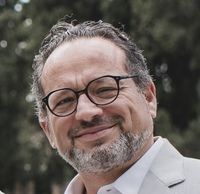
Giuseppe Riccardi Signals and Interactive Systems Lab Department of Computer Science and Information Engineering University of Trento Italy giuseppe.riccardi@unitn.it |
Abstract:
Due to the rise of easy-to-use language-based systems, generative AI has taken center stage across many industries. Neophytes and practitioners in public and private organizations have been asked to work differently and to create new products and services by delegating and supervising token-crunching computer entities. Individuals are using these systems nonchalantly for personal advice (e.g., nutrition) or social fulfillment (e.g., companionship). In the meantime, AI researchers have unveiled critical limitations of the underlying machine learning models that could hinder their inclusion in innovation processes, products, and services. This talk will review the current state of the art in conversational AI, its severe limitations, and future challenges. Beneficial technology and systems must be created ab initio through an evaluation-first approach. We will give insights into how to create fundamental research challenges while pursuing innovation in AI system training and development.

